Northern lights by campervan: where and when to go
Aurora seasons, winter road rules and official forecasts for Iceland, Norway, Lapland, Canada, Scotland, Tasmania and New Zealand by campervan.

João & Maria · Updated · 13 min read
- North: Sep to Mar
- South: Apr to Sep
- Peak 10pm to 2am
- Kp 3 to 4 can be enough
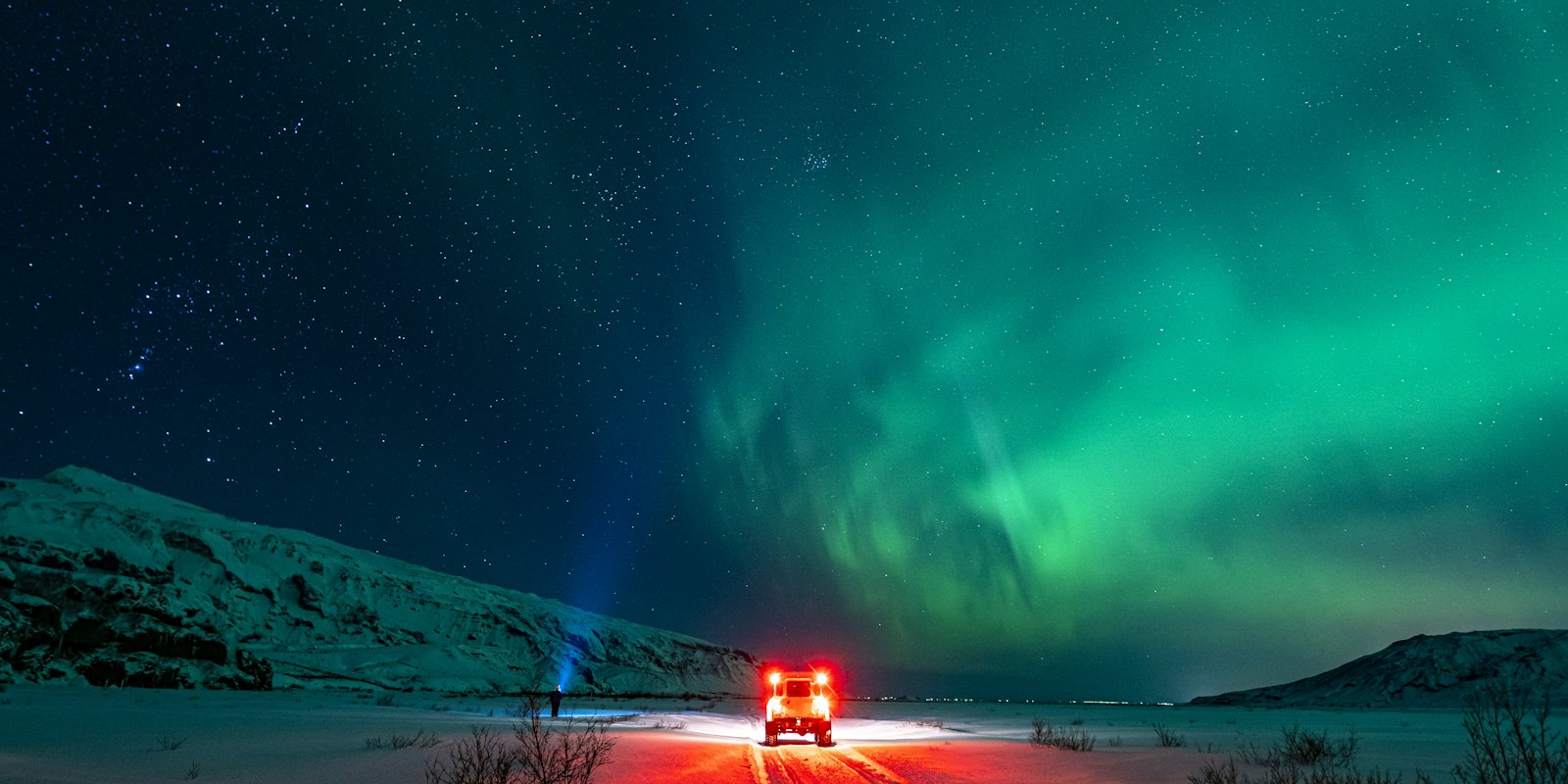
A campervan suits aurora hunting well. The lights need dark, clear skies, and the clouds that block them move around. With a van you can follow a gap in the cloud, park somewhere without street lights and wait in a heated space between checks.
The hard part is that aurora season is also winter. Roads freeze, days are short, campsites close and some rules on where vans may stay get tighter. This guide covers six regions in both hemispheres, the official forecasts and what road authorities say about winter driving. Rules change, so check each linked source before you go.
The short version
- Northern lights season runs roughly from late August or September to March or April, depending on the place. Summer nights at high latitudes are too bright.
- Southern lights (aurora australis) are best in the southern winter, roughly April to September, from Tasmania and the far south of New Zealand.
- Time of night: NOAA’s Space Weather Prediction Center says the best aurora is usually within an hour or two of midnight, roughly 10 pm to 2 am local time.
- What you need: darkness, clear skies, a view to the north (or south, in the Southern Hemisphere) and some geomagnetic activity. Under the auroral oval, a Kp of 3 or 4 can be enough.
- Plan several nights. Sightings are never guaranteed.
- Winter driving is the real risk. Check road conditions daily, use proper winter tyres where required, and have a plan for staying put when the weather turns.
When the aurora is visible
Darkness by place
The aurora is there in summer too, but you cannot see it in daylight. NOAA’s aurora overview notes that the midnight sun of polar summer prevents viewing, and that the best viewing sits under the auroral oval, between about 60 and 75 degrees latitude. There, aurora can be seen on more than half of nights in a year.
Season dates for each region are in the destination sections and table below.
The solar cycle
Aurora activity follows the sun’s roughly 11-year cycle. NOAA’s solar cycle progression page shows that the 2019 expert panel predicted the peak of Solar Cycle 25 between November 2024 and March 2026. As of October 2026, the page does not confirm when the maximum occurred. Activity still varies night to night, so the short-term forecast matters more than the cycle.
Kp, time of night and the equinoxes
NOAA’s tips for viewing the aurora explain the Kp index as a rough guide. At Kp 0 to 2 the aurora is far north and dim. At Kp 3 to 5 it is brighter and more active, and if you are in the right place under the oval, Kp 3 or 4 can give a very good display. Larger storms tend to happen around the spring and autumn equinoxes.
Dark skies and the moon
Get away from town lights. NOAA’s advice is simple: go out at night and away from city lights, and find an unobstructed view toward the pole. A full moon reduces how bright the aurora looks, though not how bright it actually is. NOAA notes a bright aurora can be seen from as far as 1,000 km (620 mi) away.
Cloud
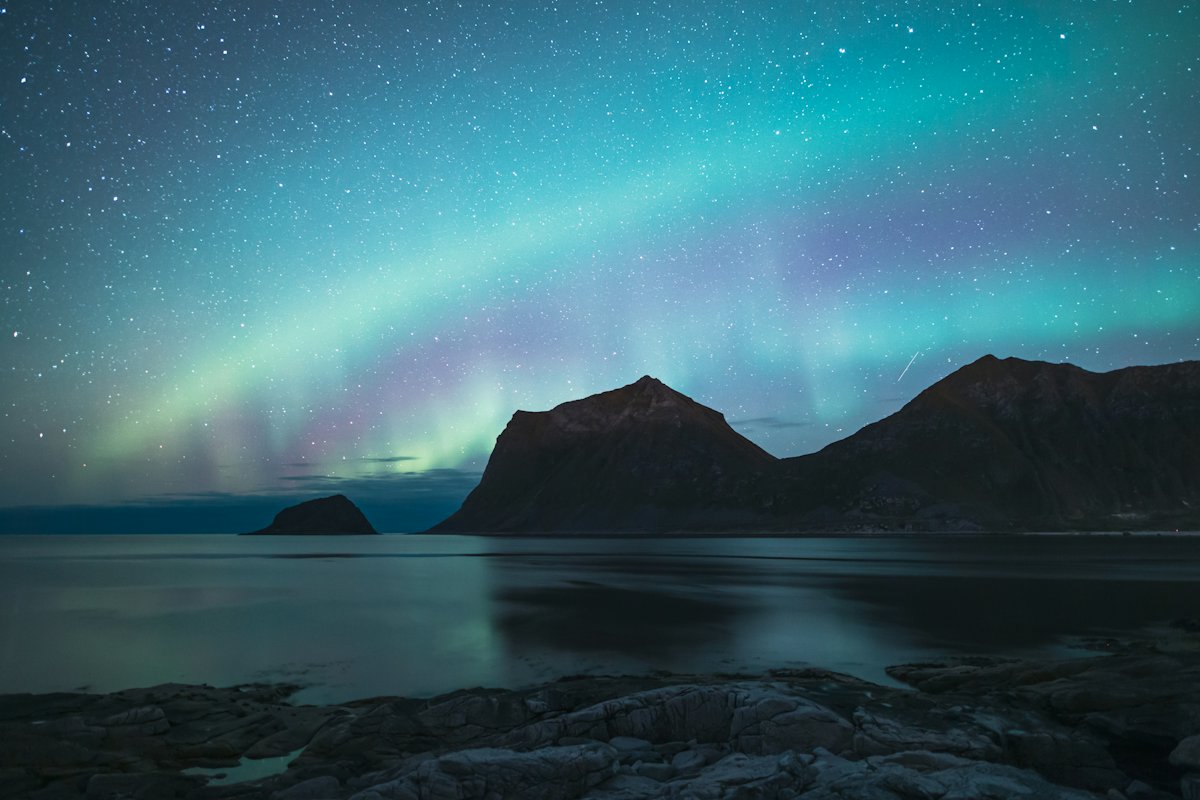
Cloud is the most common reason people miss the lights. Visit Finland calls clear skies the biggest factor and suggests checking the weather forecast alongside the aurora forecast. This is where a campervan helps: if the cloud map shows a clear patch an hour away, you can go.
Where to go by campervan
Iceland
Best months: September through April, with the equinoxes often more active and midwinter giving the longest nights. Visit Iceland suggests planning several nights and checking both cloud cover and aurora activity.
Roads and winter driving: Safetravel’s winter driving advice warns that strong winds, snow, rain and drifting snow can make driving difficult and sometimes dangerous, even when roads look clear. It recommends winter equipment such as winter tyres, checking the forecast at least once a day, and following road conditions on umferdin.is, which also lists the traffic service number 1777. Iceland requires front and rear lights on at all times, and Safetravel notes that the “AUTO” setting may not switch on the rear lights. Daylight is limited in winter, so allow extra time and keep plans flexible.
Where vans can stay: Safetravel’s camping page says camping in a campervan is restricted to campsites or privately owned land with the landowner’s permission. It does not say which campsites stay open in winter, so confirm with each campsite before you set off. For a route and campsite overview, see our Iceland campervan guide.
Northern Norway (Tromsø, Lofoten)
Best months: Visit Norway gives late August to late March, with spring and autumn showing the highest activity. It names Tromsø as the main hub, with Alta, Lyngen and Senja as quieter alternatives, plus Lofoten. It says peak activity is often between 11 pm and 2 am. In Lofoten, the dark period lasts about five to six weeks from early December, and by April 1 the sky is too bright for aurora until the next season.
Roads and winter driving: Visit Norway’s practical winter tips say the cold season runs from October to April, studded winter tyres are required in the winter months, and you should only drive if you have previous winter driving experience. Weather can close passes and bridges for hours at short notice. Coastal areas like Lofoten typically sit between 5 °C and -5 °C (41 °F and 23 °F), while inner Finnmark can drop to around -30 °C (-22 °F).
The Norwegian Public Roads Administration’s tyre rules require at least 3 mm of winter tread from 1 November to the first Sunday after Easter Monday. In Nordland, Troms and Finnmark, which cover Lofoten and Tromsø, the period is 16 October to 30 April. If you use studded tyres, all wheels must have them. Vehicles over 3,500 kg have separate rules, so check your van’s weight.
Where vans can stay: Visit Norway’s motorhome advice says the biggest cities and some municipalities limit motorhome parking to designated areas, some campsites and waste disposal points close off-season, and more ski resorts now offer motorhome parking. Our Norway campervan guide covers routes in more detail.
Finnish Lapland
Best months: End of August to April. Visit Finland lists September to October and February to March as peak times, and says the lights appear on roughly every second clear night in autumn and spring. Most of Lapland enters polar night in December and January, and in the far north the sun does not rise for weeks. The same page says a Kp of 1 to 2 may be enough in northern Lapland.
Roads and winter driving: Visit Finland’s driving guide says winter tyres are required by law when weather or road conditions call for them, from 1 November to 31 March, with a 3 mm legal minimum tread (it suggests 4 to 5 mm is safer). Headlights must be on at all times. Many smaller roads are only ploughed, not salted. Reindeer are often on or beside roads in Lapland. Stop and wait for them to move. Fintraffic’s road weather service shows conditions, warnings and cameras.
Where vans can stay: We could not find official guidance on overnight campervan parking in Lapland. Contact campsites or local tourist offices directly and confirm winter opening before you go.
Canada (Yukon and Alberta)
Yukon: Travel Yukon gives an official viewing season of mid-August to mid-April. November to March has the longest, darkest nights and serious cold. It recommends staying at least three nights. We could not source Yukon winter campground opening or highway rules for this piece, so check with Yukon’s government and local operators before you plan a winter van trip there.
Jasper, Alberta: Jasper National Park was designated a Dark-Sky Preserve on March 26, 2011, and covers over 11,000 km² (4,250 sq mi). Parks Canada says the aurora can appear on clear, cold nights, especially in winter, and recommends fall and winter nights around the new moon. Suggested spots include Pyramid Island, Jasper Lake and Old Fort Point.
Roads and winter driving: On the Icefields Parkway in winter, snow tires or chains are required from November 1 to March 31, or whenever the road is snowy or icy. There are no services along the 232 km (144 mi) road in winter, no cell coverage between the two ends, and the road is not salted. Check 511 Alberta before you go, and carry a valid national parks pass.
Where vans can stay: Parks Canada lists Wapiti winter camping from October 28, 2026 to early May 2027, with 40 electrical RV sites in Loop AA, flush toilets, showers and drinking water. There is no sani dump. Sites are first-come, first-served, and camping is permitted in designated campgrounds only. See our Canadian Rockies campervan guide for the wider route.
Scotland
Best months: VisitScotland gives October to March, usually between 9 pm and 2 am. Shetland, where locals call the aurora the “Mirrie Dancers”, Orkney and Lewis and Harris have the best odds. For campervans, the most practical option is Caithness and the North Coast 500, where you can drive to sites like Dunnet Head and Duncansby Head without a ferry. Galloway Forest Park, the UK’s first Dark Sky Park, gives the best chance this far south.
Roads and winter driving: Traffic Scotland offers a route checker for live and planned disruption, a gritter tracker, and a 24-hour care line on 0800 028 1414. It says winter tyres can reduce stopping distance by up to 40% and recommends carrying an emergency kit.
Where vans can stay: We did not find official guidance on winter campsite opening, so contact sites directly.
Tasmania and New Zealand (aurora australis)
Tasmania: Discover Tasmania says the Southern Lights can be seen across the island wherever there is an unobstructed view of the southern horizon, and that colour can look richer over water. Its winter guide calls winter the best time, thanks to longer, darker nights. July is the coldest month, with main-town temperatures of about 2 to 14 °C (36 to 57 °F).
For driving, Discover Tasmania’s winter road trip page warns that sealed and unsealed roads can become slippery with ice that is often not visible. Some roads may require snow chains, and mobile reception is patchy in many national parks. Check Tasmania Police for road closures, the Bureau of Meteorology for road weather alerts, and Tasmania Parks and Wildlife Service for campsite closures. More in our Tasmania campervan guide.
New Zealand: Southland’s regional tourism body gives April to September as the best window, with clear skies and little or no moon. It points to the Catlins (Waipapa Lighthouse, Curio Bay, Nugget Point) and spots near Invercargill and Bluff. On Stewart Island / Rakiura, a Dark Sky Sanctuary since January 2019, the local promotion association says it is dark from 7 pm to 6:30 am in June to August, compared with only midnight to 3 am in summer. The ferry from Bluff takes about an hour. It also notes that from populated areas, the aurora generally needs to be strong (Kp 4 or more). We could not open New Zealand’s national tourism or road agency pages for this piece, so check winter road and chain advice locally.
Destinations compared
| Destination | Aurora months | Winter road difficulty | Daylight in peak season |
|---|---|---|---|
| Iceland | Sep to Apr | High: wind, drifting snow, fast changes | Limited in winter |
| Northern Norway | Late Aug to late Mar | High: studded tyres required, pass and bridge closures | Polar night in Lofoten from early Dec, about 5 to 6 weeks |
| Finnish Lapland | Late Aug to Apr | Moderate to high: ploughed minor roads, reindeer | Polar night in most of Lapland in Dec and Jan |
| Yukon | Mid-Aug to mid-Apr | High: extreme cold | Longest nights Nov to Mar |
| Jasper, Alberta | Fall and winter | High on Icefields Parkway: no services, no cell, not salted | Not sourced |
| Scotland | Oct to Mar | Moderate: ice, wind, gritted trunk roads | Long nights Oct to Mar |
| Tasmania | Winter (Jun to Aug) | Moderate: hidden ice, chains on some mountain roads | Shorter winter days |
| Southern New Zealand | Apr to Sep | Check locally | On Rakiura, dark 7 pm to 6:30 am in winter |
Difficulty ratings are our summary of the official advice linked above, not an official grading.
Forecasts and apps
- Icelandic Met Office: the vedur.is aurora forecast maps cloud cover over Iceland six days ahead, with an aurora activity scale from 0 to 9. The page says the aurora needs dark and partly clear skies.
- NOAA SWPC: the 30-minute aurora forecast shows the auroral oval for both hemispheres, 30 to 90 minutes ahead, based on solar wind data. The green oval turns red when activity is forecast to be stronger.
- Australian Bureau of Meteorology: the BOM space weather aurora page issues Aurora Outlooks (3 to 7 days ahead), Aurora Watches (up to 48 hours) and Aurora Alerts when activity is in progress. It also links to a cloud cover viewer.
- Met Norway: yr.no, run with NRK, does not list an aurora forecast but does show weather warnings and mountain pass status, which matter more for a van. Visit Norway recommends its own NorwayLights app for aurora forecasts.
- Regional options: Visit Finland points to the Finnish Meteorological Institute, and VisitScotland mentions AuroraWatch alerts.
Our suggested routine: check cloud and aurora outlooks in the afternoon, choose where to park before dark, then watch the 30-minute forecast through the evening.
Winter campervan safety
Check conditions every day. Every road authority we checked says the same thing. Weather changes fast, roads close at short notice, and the safest option is often to wait. Safetravel advises waiting in a safe location until conditions improve.
Tyres. Norway and Finland set legal winter tyre periods (see above), and the Icefields Parkway requires snow tires or chains from November 1 to March 31. Confirm what your van has before you collect it.
Lights and visibility. Iceland and Finland require headlights on at all times. Do not stop in the road to watch the aurora. Visit Norway specifically warns against stopping in the middle of the road.
Heating and carbon monoxide. Northern Ireland’s government advice on carbon monoxide when camping and caravanning says to fit an audible CO alarm and replace it if it is old. Do not take a gas stove, light or heater into a caravan unless it is a permanently installed and properly maintained fixture. Never bring a lit or smouldering barbecue inside. CO has no colour or smell, and symptoms such as headaches, dizziness and nausea are often mistaken for flu. If you suspect it, open doors and windows, get outside and seek medical help.
Emergency kit and communication. Traffic Scotland recommends a winter emergency kit. Visit Norway suggests a thermal blanket, warm clothing and the 113 app, and Safetravel lists 112 as Iceland’s emergency number. Tell someone your plan before driving routes without cell coverage. Our campervan packing list has a winter section.
Photographing the aurora
Visit Norway’s photography guide gives a sensible starting point: f/2.8, ISO 1600 and 15 seconds on a tripod. Then adjust.
- Steady the camera. Use a tripod with a self-timer or remote. A rock works if you have nothing else.
- Open the aperture. Use the widest setting on your lens, often between f/1.4 and f/4.
- Shorten the exposure if the aurora is moving fast, or it will blur.
- Focus manually. Point at a bright star and adjust until it looks as small as possible.
- Batteries: cold drains them fast. Keep spares warm in an inside pocket or bring a power bank.
Visit Iceland adds a reminder: let your eyes adjust and do not judge the display only by your phone screen.
Frequently asked questions
What is the best month to see the northern lights by campervan?
There is no single best month. Official sources point to the equinox periods as more active and to midwinter for the longest nights. For a campervan, we’d lean toward the shoulder months, when roads and temperatures are usually easier.
Can I see the aurora australis from Tasmania or New Zealand?
Yes. Discover Tasmania says the Southern Lights can be seen across the island with a clear view of the southern horizon, and winter gives the best odds. In New Zealand, Southland’s tourism body gives April to September, and Stewart Island notes that the aurora generally needs a Kp of 4 or more to be seen from populated areas.
What Kp index do I need to see the aurora?
It depends on where you are. NOAA says that under the auroral oval, Kp 3 or 4 can give a very good display, and Visit Finland says Kp 1 to 2 may be enough in northern Lapland. Further from the oval, you need a stronger storm.
Can I sleep anywhere in my campervan while chasing the aurora?
Usually not. In Iceland, campervans may only stay on campsites or private land with the owner’s permission. In Norway, some cities and municipalities limit motorhome parking to designated areas, and in Jasper, camping is allowed in designated campgrounds only. Many campsites close in winter, so confirm opening before you go.
Is it safe to drive a campervan in Arctic winter?
It can be, with preparation and the right experience. Visit Norway recommends driving only if you have winter driving experience, and every road authority we checked advises checking conditions daily and waiting out bad weather.