Norway by campervan: the complete guide
Plan a Norway campervan trip: fjord roads, Lofoten, North Cape, ferries, AutoPASS tolls, right-to-roam rules for motorhomes and winter closures.
- Best late May–Sep
- 14–21 days
- Drive on the right
- Lofoten Scenic Route 230 km · 143 mi

João & Maria · Updated · 14 min read
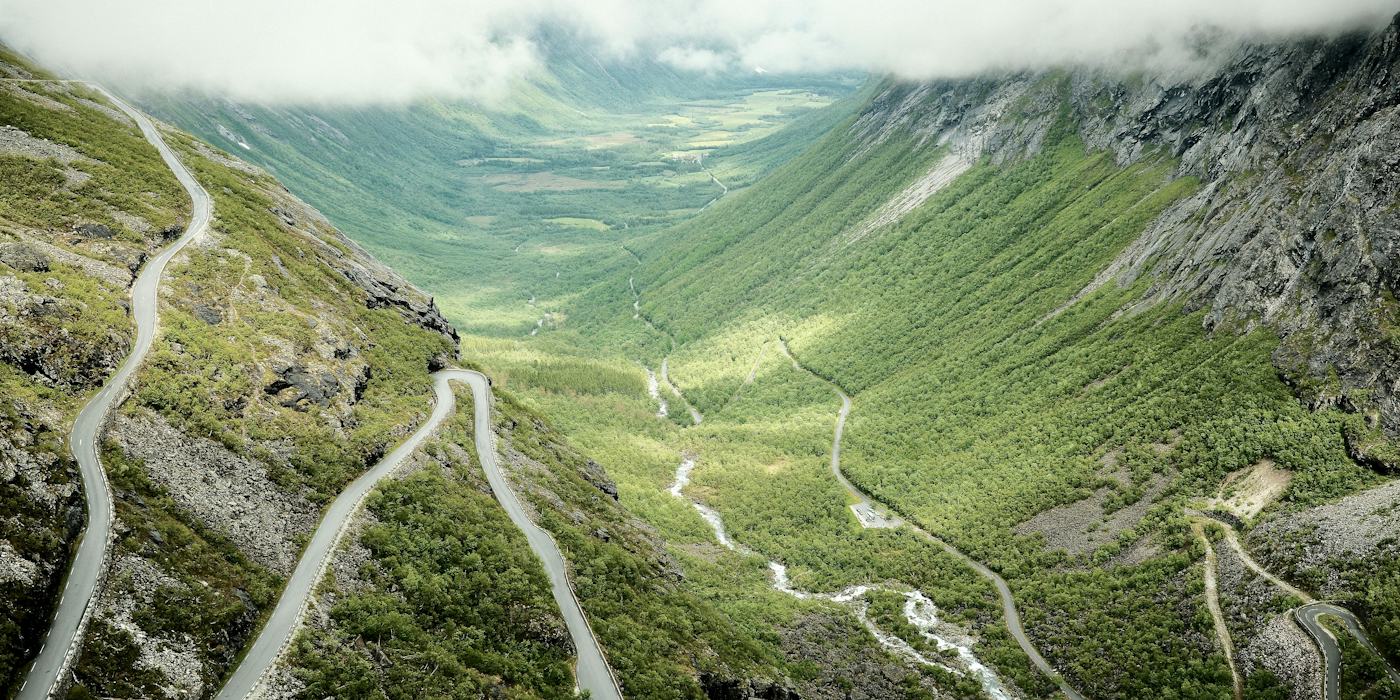
Norway is a long, narrow country of fjords, mountain passes and island chains, and a campervan lets you follow it at the pace the roads demand. You sleep close to the view, cook your own food in an expensive country, and move on when the weather turns. The trade-off is that many roads are narrow and winding, ferries are part of daily driving, and the most famous mountain roads close for months each year.
This guide suits drivers who are comfortable on slow, twisting roads and who like to plan around ferry timetables and seasonal openings. It covers the western fjords around Geiranger and Trollstigen, the Atlantic Ocean Road, Lofoten and the far north up to the North Cape, plus the rules on tolls, ferries and where you can legally spend the night.
At a glance
| Best time to go | Late May to September, when the high mountain roads are usually open |
| Trip length | 14–21 days for fjords plus Lofoten; add a week for the North Cape |
| Driving side | Right |
| Main route (distance) | Lofoten Scenic Route, Raftsundet to Å: 230 km (143 mi) |
| Overnight rules (one line) | At least 150 m (492 ft) from houses and cabins, max two nights in one spot without permission, obey local no-camping signs |
| Currency | Norwegian krone (NOK) |
| Emergency number | 112 police, 113 ambulance, 110 fire |
| Key official site | visitnorway.com and vegvesen.no |
Why go by campervan
Norway has 18 designated Norwegian Scenic Routes, selected roads with architect-designed rest areas, viewpoints and toilets. A van lets you link several of them in one trip and stop at each viewpoint without hunting for a hotel at the end of the day. Many of the routes include ferry crossings, and a van rolls straight on and off.
The right to roam (allemannsretten) also helps. Under the rules summarized by Visit Norway, motorhomes and caravans may stop on uncultivated land if they keep at least 150 m from houses and cabins and do not stay more than two nights in one place without the landowner’s permission. That freedom has limits, and popular areas such as Lofoten now have local bans. We cover those below.
A van is a poor choice in some conditions. Visit Norway warns that many roads are narrow and winding and that some Norwegian Scenic Routes do not allow motorhomes and caravans, so watch the road signs. Bridges can close temporarily in strong wind, especially in autumn and winter. Higher passes may have snow and frost in April and May and again in September and October, even when the lowlands are warm.
Winter is a different trip altogether. Several of the best-known roads close, studded or winter tyres become mandatory, and some campsites and waste disposal points shut for the season. If you are not used to snow driving, plan your van trip for summer.
When to go
Summer is the main campervan season. Trollstigen is usually open from mid-May to October or November, the midnight sun runs from mid-May to late July in the far north, and ferries run their fullest timetables. September brings fewer people and the start of the northern lights season, though mountain weather turns. From November to March you get the aurora and the polar night, with closed passes and convoy driving on some routes.
| Months | Weather | Daylight | Roads & access | Crowds |
|---|---|---|---|---|
| Apr–May | Snow and frost possible on higher passes | Midnight sun starts at the North Cape on 14 May | Trollstigen reopened 29 April and 12 June in recent years; Varanger’s Smelror–Hamningberg section opened 29 April 2026 | Low |
| Jun–Aug | Lowlands at their warmest; mountain weather can still change quickly | Midnight sun in Lofoten 28 May–14 July, Tromsø 20 May–22 July | High routes normally open; bridges can still close in wind | Highest; book key ferries ahead |
| Sep–Oct | Snow and frost possible on higher passes again | Northern lights possible from late August in the north | Trollstigen has closed as early as 5 October | Falling |
| Nov–Mar | Winter conditions, studded tyres allowed | Polar night: Lofoten early Dec–early Jan, North Cape late Nov–late Jan | Many passes closed or convoy-only; North Cape road convoy-only for the last stretch | Low, except aurora hubs such as Tromsø |
Sources for the table: Visit Norway midnight sun, Visit Norway polar night, Visit Norway northern lights and the route pages linked below.
Routes to know
Geiranger to Trollstigen
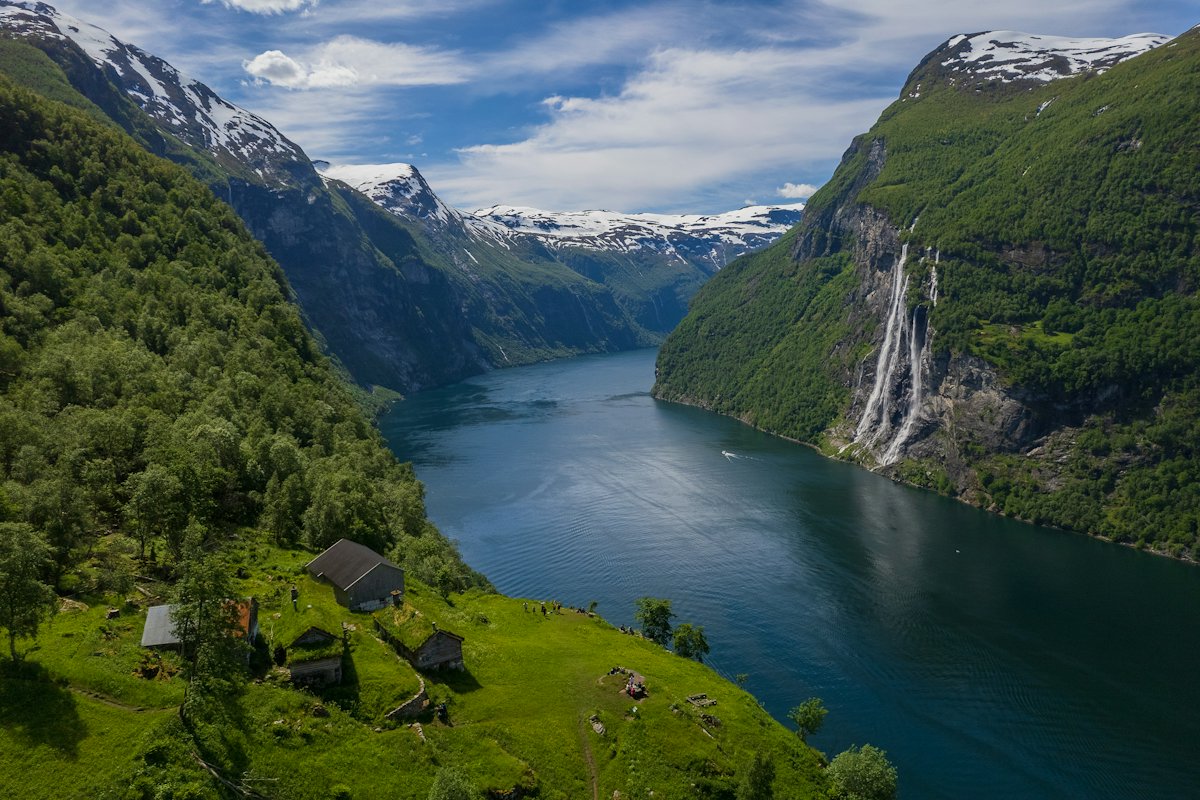
The Geiranger–Trollstigen Scenic Route runs 104 km (65 mi) between Sogge bru in Romsdalen and Strynefjellet, through Valldal and Geiranger, with one ferry crossing from Eidsdal to Linge. Allow two to three days. Highlights include the Ørnesvingen viewpoint above the Geirangerfjord, the eleven hairpin bends of Trollstigen, and the rest areas at Flydalsjuvet and Gudbrandsjuvet.
Both mountain sections close in winter. In recent years Trollstigen has closed as early as 5 October and as late as 7 December, and Langvatnet–Geiranger between 18 November and 9 January. After reopening, the road may close at night and in bad weather. One more thing to check this year: Fjord1 lists its Geiranger–Hellesylt sightseeing ferry as suspended until further notice, with 2027 details to come.
Atlantic Ocean Road
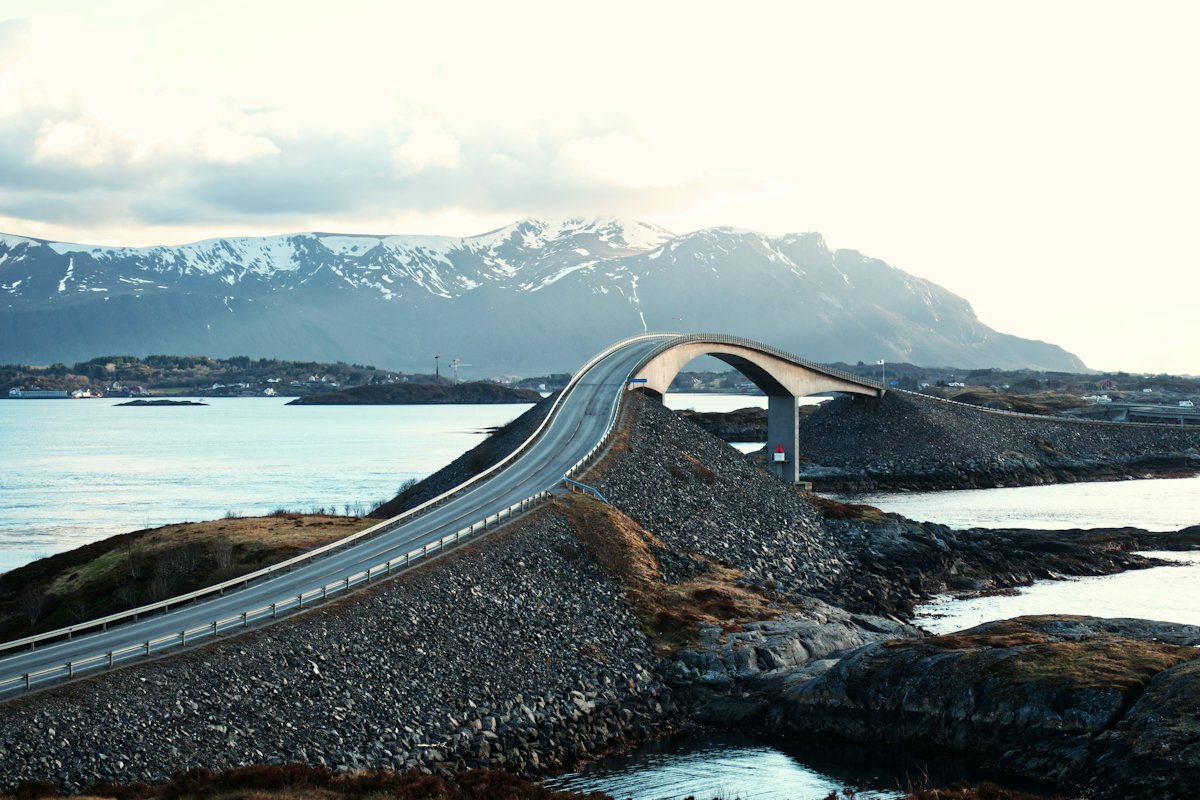
The Atlanterhavsvegen Scenic Route is short, 36 km (22 mi) from Kårvåg to Bud, and pairs well with Trollstigen as a day or two on the coast. Stop at Storseisundbrua for the classic bridge view, walk the raised loop path on Eldhusøya, and watch the sea from the pier at Askevågen. Traffic is heavy in high season and wind on the bridges can be strong. Motorhomes may not empty toilets into the route’s toilet facilities; the nearest dump stations are at Kårvåg, Vevang, Eide, Bud, Kristiansund and Molde.
Lofoten
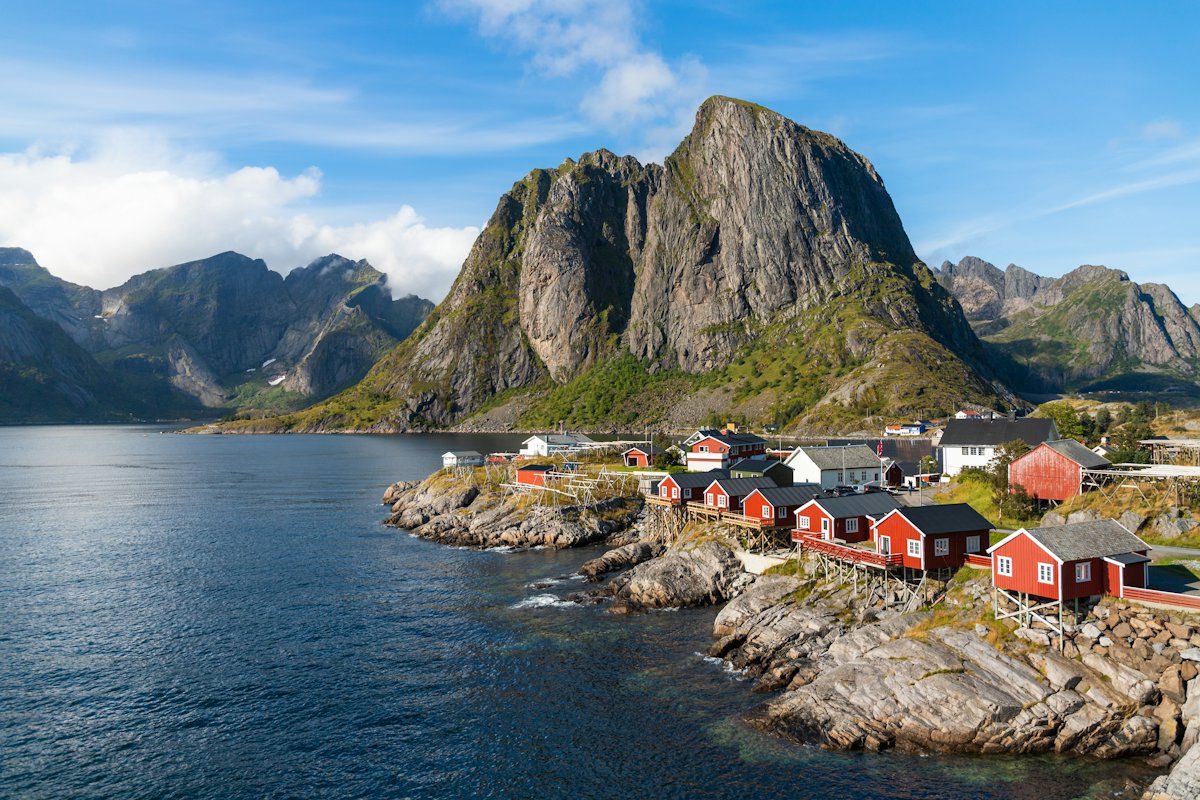
The Lofoten Scenic Route follows the E10 for 230 km (143 mi) from Raftsundet to Å. Allow four to six days. Detours lead to Nusfjord, Vikten, Utakleiv, Unstad, Eggum and Henningsvær, and rest areas include Hauklandstranda, Rambergstranda and Reinehalsen. Dump stations are listed at Reine, Hamnøy, Ramberg, Leknes, Lyngvær, Svolvær, Austnesfjorden and Torvdalshalsen.
Many travelers arrive on the Bodø–Moskenes ferry. Torghatten Nord reserves part of each departure for pre-booked vehicles and sells the rest at the dock. Reserved travelers must be in the “Reserved/Prepaid” queue 45 minutes before departure. The page gives two different booking deadlines, so book as early as you can in summer.
The far north: Havøysund, the North Cape and Varanger
The E69 runs from Olderfjord to the North Cape, about 129 km (80 mi) according to Wikipedia’s E69 entry, a secondary source. It passes through the 6.9 km (4.3 mi) North Cape Tunnel. In winter, the last stretch from Skarsvåg to the North Cape is open only to convoys at fixed times, and only when weather permits. The North Cape has the longest midnight sun window on the mainland, 14 May to 29 July.
Nearby, the Havøysund Scenic Route covers 67 km (42 mi) from Kokelv to Havøysund through bare coastal rock, with chances of sea eagles and reindeer. Further east, the Varanger Scenic Route runs 160 km (99 mi) from Varangerbotn to Hamningberg and is known for birdlife. The Smelror–Hamningberg section is closed in winter; it most recently opened on 29 April 2026. Allow at least a week for the far north from Lofoten.
Where you can sleep
Campsites and motorhome stopovers
Campsites are the simplest option and, in busy areas, the one Visit Norway recommends. It advises calling ahead in peak summer, booking for longer stays, and using campsites and designated motorhome spaces, especially in high season. The biggest cities and some municipalities allow parking and camping only in designated areas. For prices, the PiNCAMP Price Analysis 2026, summarized by Camperchamp (a secondary source), puts the average peak-season pitch for a motorhome or caravan at €38 a night for a family, about 15% less outside peak season. Individual sites vary, so check each one.
Right to roam for motorhomes
The right to roam applies to people. Vehicles have their own limits. Visit Norway sets out what this means for a van:
- You may park on the road shoulder along public roads next to uncultivated land unless signs prohibit it.
- Keep at least 150 m (492 ft) from houses and cabins.
- Do not stay more than two nights in the same place without the landowner’s permission, except in the mountains or very remote areas.
- Keep at least 4 m (13 ft) between your van and other tents, motorhomes or caravans for fire safety.
- Do not drive or park on uncultivated land, and do not park in passing places.
Miljødirektoratet, the Norwegian Environment Agency, confirms the 150 m and two-night rules and states that the right of access does not include driving motor vehicles on outlying land. It also notes that municipalities manage the right and can restrict access, charge fees or close vulnerable areas. The underlying law is the Outdoor Recreation Act; the English version on regjeringen.no is an unofficial translation.
What is not allowed
Fires in or near forest and other outlying land are banned from 15 April to 15 September without municipal permission. In extreme drought, Visit Norway says barbecues, gas burners and camping stoves can also be banned. Do not camp on cultivated land, in gardens or in farmyards. In Lofoten, Visit Lofoten asks drivers to obey signs that ban parking, camping or overnight stays for motorhomes, and links to a map of camping and parking bans. Expect these signs at popular spots, and treat the sign on the ground as the rule that applies.
Dump stations and services
Empty toilets and grey water only at emptying stations, never in rest-area toilets. The Scenic Route pages list the nearest dump stations for each route, and Visit Norway points to bobilplassen.no for motorhome parking and disposal points. Some campsites and disposal points close in the off-season, so check before a shoulder-season trip.
Driving rules and road conditions
Speed limits
According to Visit Norway, the limit is 50 km/h (31 mph) in built-up areas unless signed otherwise, as low as 30 km/h (19 mph) in residential areas, 60–80 km/h (37–50 mph) on most rural roads, and up to 110 km/h (68 mph) on some motorways and dual carriageways. Heavy vehicles over 3.5 tonnes and vehicles towing caravans or trailers are limited to 80 km/h (50 mph). The same page says motorhomes under 7.5 tonnes follow standard car limits. If your van weighs more than 3.5 tonnes, confirm which limit applies with Statens vegvesen before you go.
Other rules
Dipped headlights are required at all times. Vehicles must carry a high-visibility vest and a warning triangle. The blood alcohol limit is 0.02%. Using a hand-held phone while driving is prohibited. Children under 36 kg or 135 cm must use a car seat.
Licence and permits
Statens vegvesen says most non-EU/EEA licences can normally be used for three months from arrival. You also need an International Driving Permit if your licence has no photo, is written in a non-Latin alphabet, or uses categories that differ from the Geneva or Vienna Convention categories. The page does not mention US licences specifically, so check your own case before you travel. UK and Swiss licences carry the same rights as EEA licences.
Vehicle size and narrow roads
The maximum vehicle width is 2.55 m (8.4 ft), and some secondary roads are narrower. The maximum combined length of car and caravan is 18.75 m (61.5 ft); above 12.40 m (40.7 ft), check in advance whether your route allows it. There is no general height limit, but low tunnels and bridges are signposted. On some Scenic Route stretches, oncoming traffic can only pass at designated passing points, and on Trollstigen buses are limited to 13.3 m (43.6 ft).
Tolls
All toll stations in Norway are automated, according to AutoPASS, and all vehicles must pay. Foreign-registered vehicles have two options set out on the AutoPASS foreign vehicles page. You can register with Epass24 and drive without a tag; there are no discounts, but you avoid the fee for looking up the owner in your home country’s register. Or you can sign an agreement with a toll service provider and get a windscreen tag with 20% off each transaction. Tags for vehicles up to 3,500 kg cannot be obtained at the border, so order well ahead. If you register nothing, an invoice is sent to the vehicle’s owner. Vehicles over 3,500 kg have separate rules, so check them if your motorhome is heavy.
Ferries
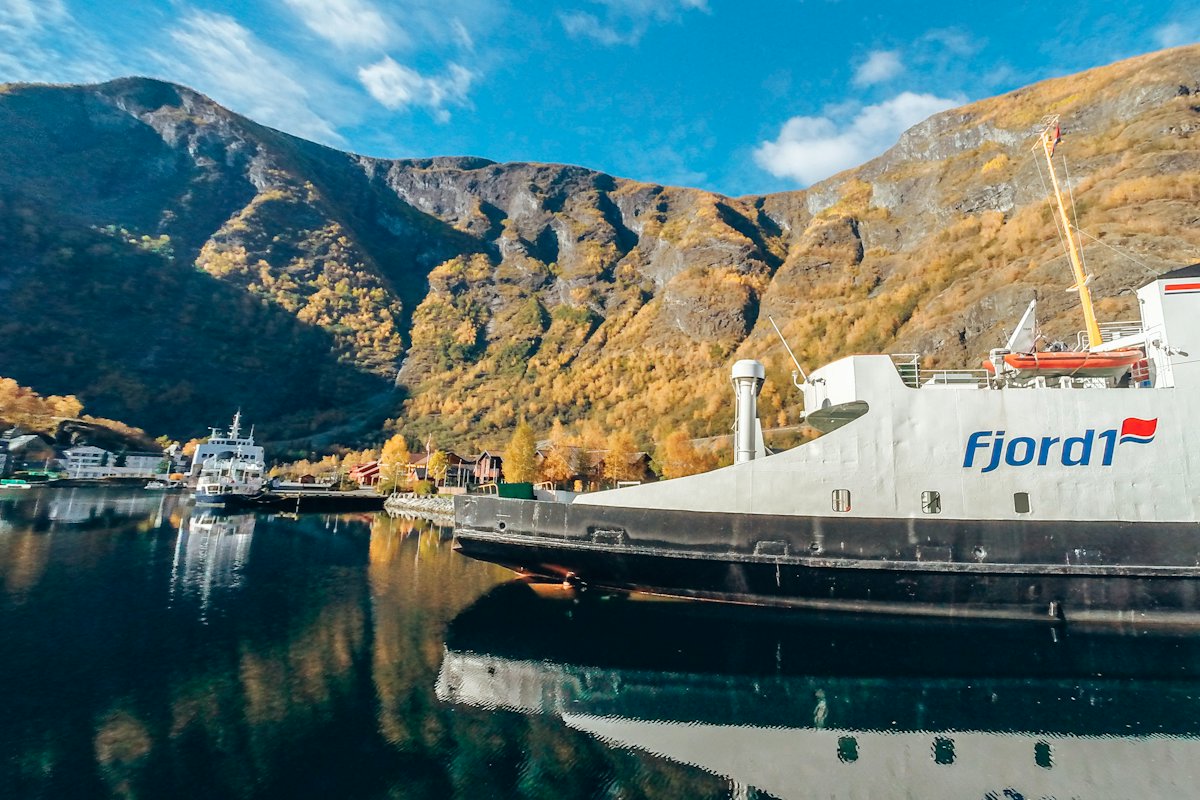
Ferries are part of normal driving in western and northern Norway. AutoPASS for ferry lists the payment options: a prepayment agreement with a registered tag (40–50% discount), an approved tag without prepayment (10% discount), FerryPay (no discount, no invoice fee), card payment to the crew on board, or an invoice mailed to the owner with a NOK 35 fee. Fares depend on total vehicle length, including bike racks. Visit Norway recommends booking popular summer ferries in advance, naming Bodø–Moskenes, Bognes–Lødingen and Lauvvik–Lysebotn.
Mountain passes and winter
Visit Norway says winter tyres are required in winter. Studded tyres are allowed from 1 November to the first Sunday after Easter, and in Nordland, Troms and Finnmark from 15 October to 1 May. Vehicles of 3.5 tonnes or more must carry snow chains that fit when ice or snow is expected. Mountain passes can close in heavy snow or strong wind, and some run as convoys behind snowplows.
Live conditions
Check the Statens vegvesen traffic information page before each drive. It links to the road and traffic map, a mountain pass filter, web cameras, ferry routes and ferry fares. The Scenic Route pages give the traffic information line +47 815 48 991. Visit Norway lists 22 175 175 for reporting hazardous road situations.
What it costs
| Item | Typical cost | Source and date |
|---|---|---|
| Campsite pitch, motorhome or caravan | €38 per night average in peak season, about 15% less off-peak | PiNCAMP Price Analysis 2026 via Camperchamp (2026 price) |
| Bodø–Moskenes vehicle reservation fee | NOK 130 (up to 6 m), NOK 170 (6.01–8 m), NOK 200 (8.01–10 m), added to the fare | Torghatten Nord (2026 price) |
| Ferry invoice fee if you have no payment agreement | NOK 35 per invoice | AutoPASS for ferry (as of October 2026) |
| Ferry discount with prepayment agreement | 40–50% off fares | AutoPASS for ferry (as of October 2026) |
| Road toll discount with a toll tag | 20% off each passage | AutoPASS (as of October 2026) |
| Studded tyres in city centers | Fee charged in Bergen, Trondheim and Oslo | Visit Norway (as of October 2026) |
| Fuel | High and varies by location | Visit Norway (as of October 2026) |
Prices change, so treat these as a starting point. To budget, add up your nightly accommodation first: a mix of campsites and free right-to-roam nights is common, and campsites cost less outside peak season. Then list every ferry on your route and price each one by your van’s total length on the operator’s site, since length drives the fare. Tolls and fuel are the hardest to predict, so leave a margin for both, and fill up before remote stretches where stations are far apart.
Tips
- Register for tolls before you leave home. Sign up with Epass24 or get a toll tag through AutoPASS, since tags for light vehicles are not issued at the border.
- Set up ferry payment too. FerryPay or an AutoPASS ferry agreement avoids the NOK 35 invoice fee, and a prepayment agreement cuts fares by 40–50%.
- Measure your van with the bike rack on. Ferry fares and reservation fees are based on total length, so know the real figure.
- Check opening dates for every mountain road. Trollstigen and Langvatnet–Geiranger close in winter and can close at night or in bad weather after reopening.
- Watch for no-camping signs. Local bans override the general right to roam, especially in Lofoten.
- Keep 150 m from houses and move on after two nights. That is the core rule for overnight stops outside campsites.
- Use dump stations, never rest-area toilets. Scenic Route pages list the nearest emptying points for each route.
- Respect the fire ban. Fires in outlying land are banned from 15 April to 15 September without municipal permission.
- Pull over and let queues pass. Visit Norway asks slower vehicles to use pull-outs, and passing places are for passing, not parking.
- Use a low gear on long descents. Visit Norway advises this to stop brakes overheating, and recommends watching the temperature gauge on climbs.
Frequently asked questions
Can you wild camp in a campervan in Norway?
Yes, within limits. Visit Norway says motorhomes may stop on the roadside next to uncultivated land if they stay at least 150 m from houses and cabins and do not remain more than two nights in one place without the landowner’s permission. You may not drive or park on uncultivated land or in passing places, and local no-camping signs must be obeyed.
How do foreign campervans pay tolls in Norway?
All toll stations are automated. Foreign-registered vehicles can register with Epass24 and drive without a tag, or sign an agreement with an AutoPASS toll service provider for a windscreen tag with a 20% discount. Without either, an invoice goes to the vehicle owner and a fee for looking up the owner may be added.
When is Trollstigen open?
Visit Norway says Trollstigen is usually open from mid-May to October or November and is closed in winter. In recent years it has closed as early as 5 October and reopened as late as 12 June. Check the Norwegian Scenic Routes page and Statens vegvesen before you go, because it can also close at short notice in heavy rain.
Do I need an International Driving Permit to drive in Norway?
Statens vegvesen says most non-EU/EEA licences can be used for three months from arrival. You need an International Driving Permit as well if your licence has no photo, uses a non-Latin alphabet, or has categories that differ from the Geneva or Vienna Convention. Check the vegvesen.no page for your own licence before you travel.
When can you see the midnight sun and northern lights in Norway?
Visit Norway lists the midnight sun at the North Cape from 14 May to 29 July and in Lofoten from 28 May to 14 July. The northern lights season runs from late August to late March, with the highest activity in spring and autumn. There is no guarantee the lights will appear on any given night.