New Zealand by campervan: the complete guide
Plan a New Zealand campervan trip: 2026 green warrant rules, DOC campsite fees, the Cook Strait ferry, Milford Road, Haast Pass and driving on the left.
- Best Nov–Apr
- 14–21 days for both islands
- Drive on the left
- Christchurch–Queenstown via Mt Cook ≈ 590 km · 370 mi

João & Maria · Updated · 14 min read
New Zealand is built for slow road trips. Two main islands, short distances on paper, and roads that twist through mountains, along lakes and over hundreds of one-lane bridges. A campervan lets you stop where the views are and sleep close to the walks, from Department of Conservation campsites by a lake to full-service holiday parks in town.
It suits travellers who are happy to drive a few hours a day, cook their own meals and plan around the weather. It suits people less well if they want to cover both islands in a week. Winding roads stretch driving times, and the rules on where you can sleep overnight changed in 2026, so a little homework pays off.
At a glance
| Best time to go | November to April for long days and open roads; winter brings frost and snow to inland South Island roads |
| Trip length | 14–21 days for both islands; 10–14 days for one island |
| Driving side | Left |
| Main route (distance) | Christchurch to Queenstown via Lake Tekapo and Aoraki/Mount Cook, about 590 km (370 mi) |
| Overnight rules | Freedom camping on council land generally needs a green-warrant self-contained vehicle; DOC campsites and holiday parks are open to all |
| Currency | New Zealand dollar (NZ$) |
| Emergency number | 111 (Police, Fire, Ambulance) |
| Key official site | doc.govt.nz for camping; NZTA Journey Planner for roads |
Why go by campervan
A van solves the two hardest parts of a New Zealand road trip: distance between towns and the need to book beds far ahead. The Department of Conservation (DOC) runs more than 320 campsites across the country, according to DOC, many of them right at trailheads and lake shores. On a route like the Haast Pass highway, DOC lists four campsites and ten short walks along a single 140 km (87 mi) stretch of road. With a van you can walk in the morning, drive at midday and sleep beside the next track.
It also makes the Cook Strait ferry simple. You drive on in Wellington, drive off in Picton, and keep your kitchen and bed with you. Both ferry operators carry campervans and motorhomes.
There are times a van is a harder choice. Inland South Island winters are cold. Earth Sciences New Zealand (formerly NIWA) lists typical winter daytime highs of 3–11°C (37–52°F) around Lake Tekapo and Queenstown, with frequent, often severe frosts and occasional snow. Alpine roads such as the Milford Road may need snow chains in winter. And from 7 June 2026, only vehicles with a green self-containment warrant can freedom camp on most public land, so a van without a fixed toilet limits you to paid campsites.
Driving times also run longer than distances suggest. The visiting-drivers site Drive Safe notes that winding roads often take longer than expected and suggests driving 1–2 hours at a time with regular breaks.
When to go
New Zealand’s seasons run opposite to the Northern Hemisphere. Summer (December to February) brings the longest days and the busiest roads and ferries. Autumn (March to May) is often settled and quieter. Winter (June to August) is mild in the far north but cold inland in the South Island. Spring (September to November) is changeable, and alpine roads can still see snow. The temperatures below are typical daytime highs from Earth Sciences New Zealand regional climate pages, and daylight figures are for Christchurch from sunrisesunset.io.
| Months | Weather | Daylight (Christchurch) | Roads & access | Crowds |
|---|---|---|---|---|
| Dec–Feb (summer) | Highs 22–26°C (72–79°F) in the north, 20–26°C (68–79°F) inland South Island, occasionally above 30°C (86°F) | Up to 15 h 26 min around 22 December | All main routes normally open; summer traffic lights can add up to 20 minutes at the Homer Tunnel | Busiest season; book daytime ferry sailings early in holiday periods |
| Mar–May (autumn) | Mild, cooling through May; inland frosts begin | About 12 h at the March equinox, shortening fast | Generally open; check alpine passes late in the season | Quieter after summer holidays |
| Jun–Aug (winter) | Highs 12–17°C (54–63°F) in the north; 3–11°C (37–52°F) inland South Island with frosts and occasional snow | As short as 8 h 55 min around 21 June | Snow chains may be required on the Milford Road; check road snowfall warnings | Quietest on the road outside ski areas |
| Sep–Nov (spring) | Changeable; late winter and early spring are often the most unsettled in places like Nelson | About 12 h at the September equinox, lengthening | Alpine passes can still get snow; check MetService road snowfall warnings | Building toward summer |
Routes to know
These four routes cover the classic South Island loop and the far north of the North Island. Most visitors join them with the Cook Strait ferry between Wellington and Picton. Interislander lists a sailing time of 3.5 hours, and Bluebridge runs four sailings each way on most days. Both take campervans. Bluebridge notes that vehicle length matters more than height, so give the correct length when you book. Interislander advises booking early for daytime sailings during peak holiday periods.
Christchurch to Queenstown via Lake Tekapo and Aoraki/Mount Cook
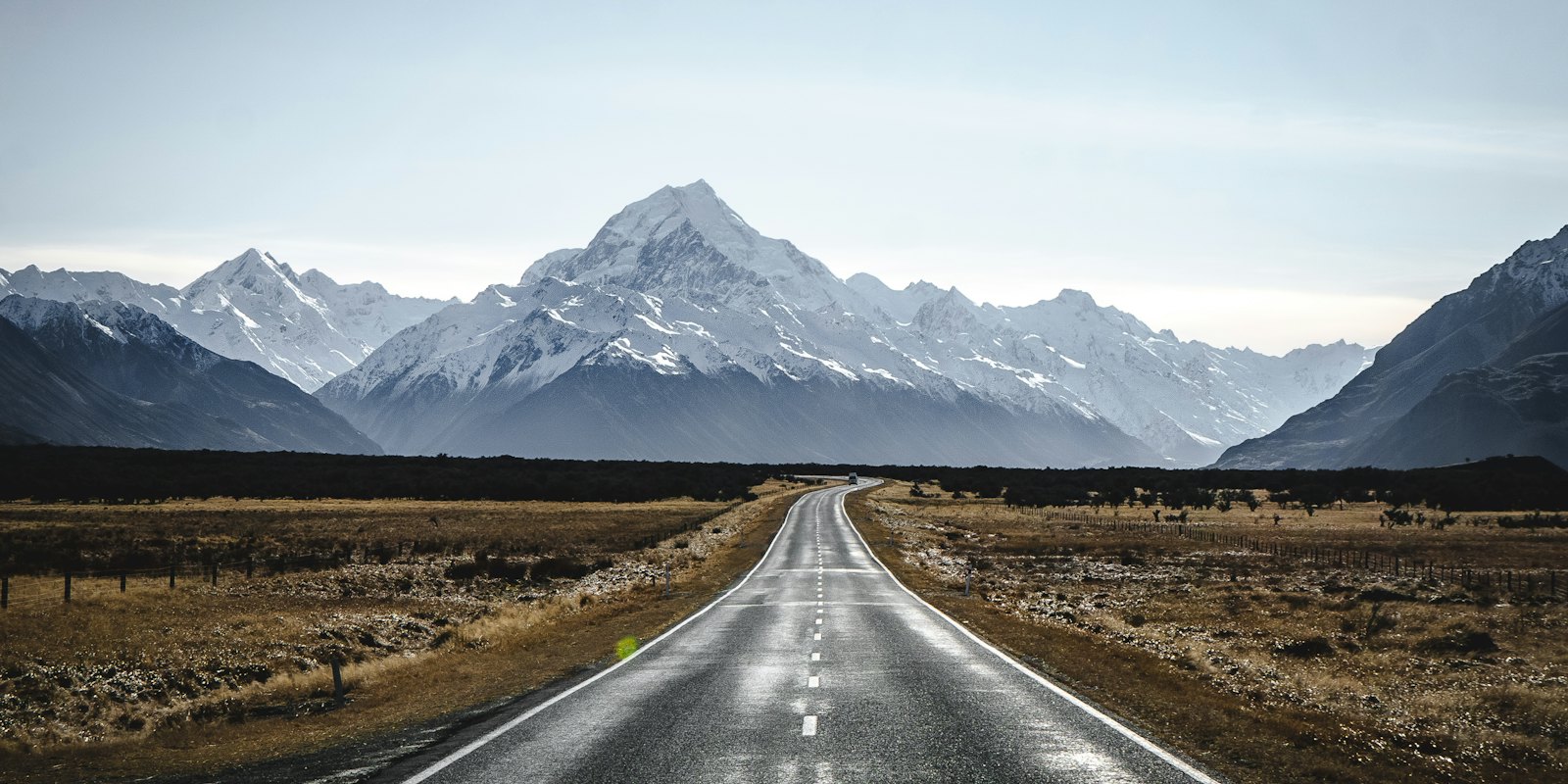
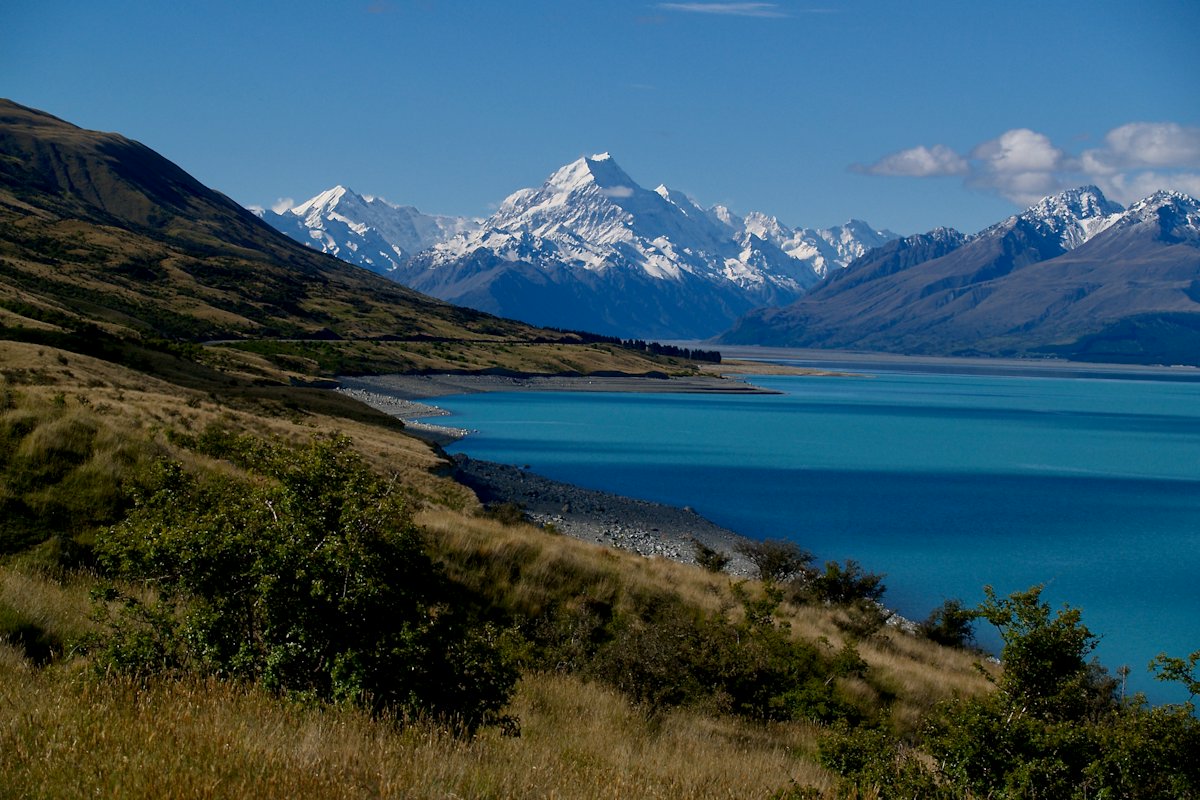
About 480 km (300 mi) direct through Lake Tekapo, or roughly 590 km (370 mi) with the return detour to Aoraki/Mount Cook Village. Allow 3–5 days. Mackenzie NZ, the regional tourism body, puts Christchurch to Lake Tekapo at about three hours, and Lake Tekapo to Aoraki/Mount Cook Village at 1 hour 15 minutes. The area sits inside the Aoraki Mackenzie International Dark Sky Reserve. State Highway 80 runs about 55 km (34 mi) along Lake Pukaki to the village and includes a few one-lane bridges. South of Twizel, SH8 crosses the Lindis Pass at about 971 m (3,186 ft) before dropping to Cromwell and Queenstown.
West Coast and the Haast Pass
The Haast Pass Tioripatea Highway is a 140 km (87 mi) section of State Highway 6 linking Wānaka and Haast. Allow at least a full day, and two if you want to walk. DOC lists ten short walks along it, including Blue Pools, Fantail Falls and Thunder Creek Falls, and four campsites: Pleasant Flat, Cameron Flat, Boundary Creek and Kidds Bush Reserve. In winter the pass can receive snow at lower levels than other alpine roads, so check road snowfall warnings before you set out.
The Milford Road (Te Anau to Milford Sound)
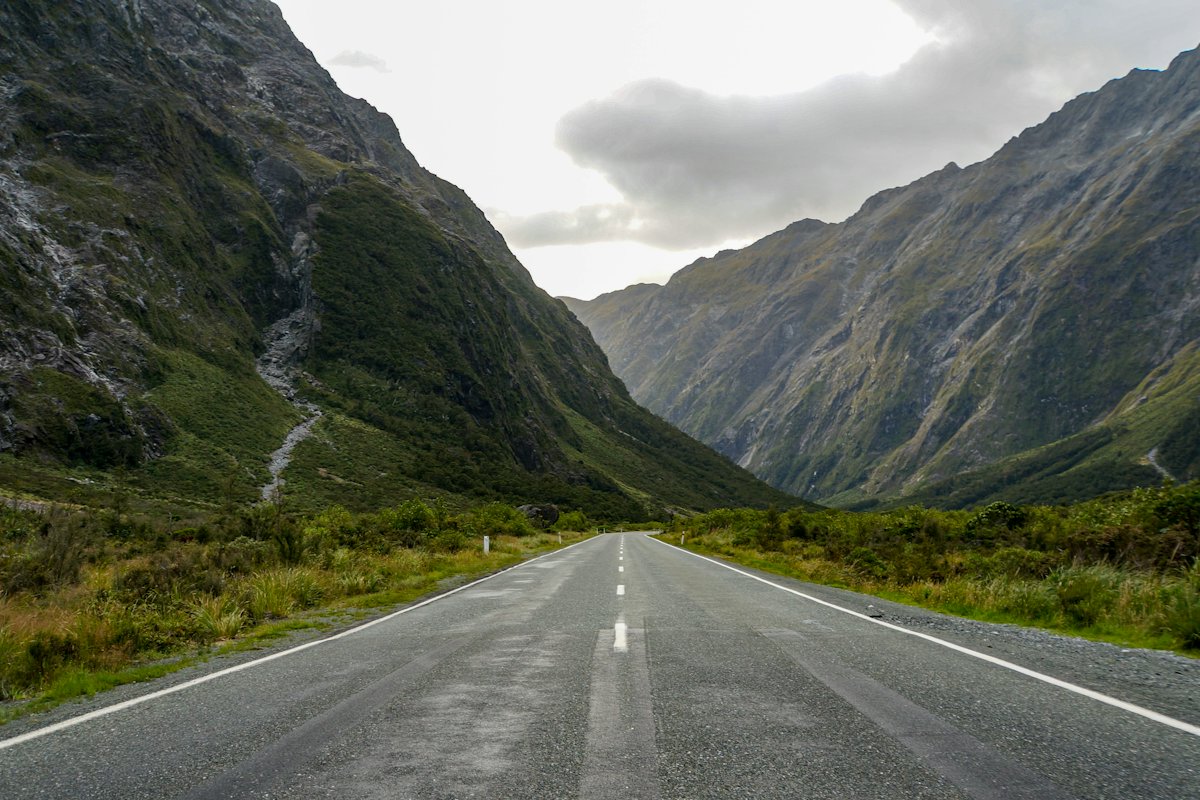
The return trip from Te Anau to Milford Sound is 240 km (149 mi). DOC suggests allowing about eight hours for the round trip with stops, short walks and a cruise, and 12–14 hours if you go from Queenstown. There is no fuel between Te Anau and Milford Sound, mobile coverage is limited, and there are no campervan dump stations on the road itself; the nearest are at Te Anau and Manapōuri. The Homer Tunnel is about 1.2 km (0.75 mi) long and descends steeply toward Milford. The section between the Hollyford Road junction and The Chasm is a restricted no-stopping zone because of avalanche risk. Chains may be required in winter; roadside signs tell you when. Several DOC campsites sit between Te Anau and The Divide.
Northland: the Twin Coast Discovery Route
Northland’s regional tourism site describes the Twin Coast Discovery as a circular route of about 800 km (500 mi) from Auckland, suggested over seven nights. It runs up the west coast through the Kauri Coast and Hokianga to Te Rerenga Wairua/Cape Reinga, then returns down the east coast through Kerikeri, the Bay of Islands, Whangārei and the Tūtūkākā Coast. It is a good warm-weather option, since Northland’s winter highs typically sit at 12–17°C (54–63°F).
If you head east of Auckland to the Coromandel instead, note that the car park at the top of Grange Road in Hāhei is closed to parking. Thames-Coromandel District Council directs visitors to the free visitor car park at the village entrance, with a shuttle or walk to the Cathedral Cove track. DOC says the track is open as of October 2026 but closes, and the shuttles stop, when an orange or red weather warning is issued for Hāhei.
Where you can sleep
DOC campsites
DOC groups its campsites into categories, and fees follow the category. Figures below are from DOC’s facilities and fees page as of October 2026. DOC notes individual campsites can differ, so check each site’s page.
- Serviced: flush toilets, tap water, kitchen bench, hot showers and rubbish collection. Unpowered NZ$25 per adult per night; powered NZ$20–28 per adult.
- Standard: toilets and water from a tap, stream or lake; some have cold showers or picnic tables. NZ$10–20 per adult per night, with some seasonal pricing.
- Basic: very limited facilities and untreated water. Free, and you must be fully self-sufficient.
- Backcountry and Great Walk campsites: fees vary and most are reached on foot rather than by van.
Children aged 5–17 pay about half the adult rate and children under 5 stay free. Each campsite page says whether you need to book. DOC also warns that if you book or occupy a site you don’t intend to use, a fee for two adults applies.
If you plan to use DOC sites often, the DOC Campsite Pass costs NZ$295 per adult and NZ$147.50 per child (5–17) for 365 nights. It covers most DOC campsites, with a limit of 7 nights in any 30-day period at one site. Powered sites cost an extra NZ$3 per person per night, and some campsites are excluded. Do the maths for your trip length before buying.
Holiday parks
Commercial holiday parks fill the gaps in towns and resort areas. Holiday Parks New Zealand lists 230 member parks from Northland to Southland, with campervan sites alongside cabins and motels. Prices vary by park and season and are set by each park, so check directly.
Freedom camping and the green warrant
Freedom camping means sleeping outside a designated campground on public land. The rules tightened under the 2023 law changes, and the transition period for older certificates has now ended.
- Green warrant only. From 7 June 2026, DOC says a vehicle needs a green warrant to count as certified self-contained. The older blue warrants are no longer recognised for freedom camping.
- Fixed toilet required. Portable toilets no longer qualify. The toilet must be fixed to the vehicle floor. Certification also covers water supply, wastewater, ventilation, a sink and rubbish storage, according to Camping Our Way, which notes that a green warrant is valid for four years and is issued by certification authorities under a system led by the Plumbers, Gasfitters and Drainlayers Board.
- Council land. In general, you can only freedom camp on local council land in a certified self-contained vehicle, and each council can add its own bylaws. Look for signs and check the local council’s website.
- DOC land. You can generally freedom camp on public conservation land except where it is prohibited or restricted. Scenic and recreation reserves are off-limits unless DOC provides a campsite, and dogs are not allowed in national parks. DOC keeps a list of prohibited and restricted areas.
- Display the warrant. In areas restricted to self-contained vehicles, the warrant card must be on display.
- Fines. Campers face a NZ$400 infringement notice if their vehicle is on public land without a green warrant, as reported by 1News. DOC notes that damaging the area or dumping waste can also bring a fine.
A “No Camping” sign means no overnight camping within 200 m (656 ft). A “self-contained vehicles only” sign means only certified vehicles may stay. If your van has no green warrant, plan on DOC campsites and holiday parks every night.
Dump stations and waste
Empty grey and black water only at proper dump stations, never on the roadside. DOC’s freedom camping rules require you to manage all waste, including human waste, and breaking them can bring a fine.
Driving rules and road conditions
Licences
NZ Police say you can drive on a current, valid overseas licence or international driving permit for up to 12 months from the date you arrive. If your licence is not in English, you must carry an accurate English translation or an international driving permit. A temporary 18-month allowance for overseas car licences applied to people arriving between November 2024 and October 2026. Community Law explains that it is revoked on 1 November 2026, so anyone arriving on or after that date returns to the 12-month limit.
Speed limits and key rules
The figures below come from Drive Safe, a visiting-drivers site owned by Tourism Industry Aotearoa. Always follow the signs.
- Open roads: typically 100 km/h (62 mph) unless signposted lower, such as 80 km/h (50 mph). Some expressways allow 110 km/h (68 mph) where signposted.
- Roadworks: usually 30 or 50 km/h (19 or 31 mph). School zones drop to 40 or 30 km/h (25 or 19 mph) at drop-off and pick-up times.
- Keep left and let traffic pass. On open roads, if five or more vehicles are queued behind you, pull over safely to let them by.
- One-lane bridges. The sign shows who has right of way. The large arrow marks the vehicle that goes first; if you’re unsure, let the other vehicle go.
- Alcohol: the limit is 0.05% blood alcohol for drivers 20 and over, and zero for drivers under 20.
- Phones: handheld use while driving is illegal.
- Seatbelts: everyone must wear one, and children under 7 need an approved child seat.
Ferries, passes and chains
The only vehicle link between the islands is the Cook Strait ferry, so book it as soon as your dates are firm. Alpine roads such as the Milford Road (SH94), Haast Pass (SH6), Lindis Pass (SH8), Arthur’s Pass and Lewis Pass can get snow. MetService issues road snowfall warnings for named passes. On the Milford Road, chains may be needed in winter; you can rent them in Te Anau, and DOC suggests learning to fit them before you leave.
Live road conditions
The NZTA Journey Planner shows state highway closures, incidents, roadworks and traffic cameras. It is updated around the clock, but it does not cover council-managed local roads, so check the regional council for those. We’d check it every morning on mountain routes and the West Coast.
What it costs
| Item | Typical cost | Source and date |
|---|---|---|
| DOC serviced campsite | NZ$25 per adult (unpowered); NZ$20–28 (powered) | DOC, October 2026 |
| DOC standard campsite | NZ$10–20 per adult | DOC, October 2026 |
| DOC basic campsite | Free | DOC, October 2026 |
| DOC Campsite Pass (365 nights) | NZ$295 adult; NZ$147.50 child; +NZ$3 per person on powered sites | DOC, October 2026 |
| International Visitor Conservation and Tourism Levy | NZ$100 per eligible visitor, paid with visa or NZeTA | Immigration New Zealand, since 1 October 2024 |
| Cook Strait ferry with campervan | Varies by vehicle length, season and sailing | Interislander, Bluebridge; quote at booking |
| Fuel | Check current board prices | MBIE weekly fuel price monitoring |
| Freedom camping fine (no green warrant) | NZ$400 | 1News, June 2026 |
Prices change, so treat these as a starting point. To budget, split your nights between DOC sites, holiday parks and freedom camping (if your van qualifies), then add the ferry, fuel for your planned distance and the levy.
Tips
- Check the warrant before you book. If you want to freedom camp, confirm the van has a fixed toilet and a current green warrant. Without one, every night is a paid campsite.
- Book the ferry first. The Cook Strait crossing is the one fixed point in a two-island trip. Give the operator your exact vehicle length.
- Rest after a long flight. Drive Safe suggests allowing 24–48 hours after arrival before starting a long drive.
- Plan short driving days. Winding roads slow you down. Aim for 1–2 hours behind the wheel between breaks.
- Fill up in Te Anau. There is no fuel on the Milford Road, and the nearest dump stations are in Te Anau and Manapōuri.
- Don’t stop in the avalanche zone. Between the Hollyford Road junction and The Chasm, stopping is prohibited.
- Check the Journey Planner daily. Closures on alpine passes and the West Coast can happen quickly.
- Read the campsite page. Each DOC campsite page states the fee, how to pay and whether you need to book. Don’t book sites you won’t use.
- Keep your warrant visible. In self-contained-only areas, the warrant card must be displayed.
- Know the emergency numbers. Call 111 for Police, Fire or Ambulance. Calls are free, even from a mobile phone with no credit.
Frequently asked questions
Can you freedom camp in New Zealand in a campervan?
Yes, in many places, but on most council land your vehicle must be certified self-contained with a green warrant. From 7 June 2026, older blue warrants no longer count, and a fixed toilet is required. Local councils and DOC can prohibit or restrict camping in specific areas, so always follow the signs. Campers without a green warrant on public land face a NZ$400 infringement notice.
How much do DOC campsites cost?
DOC campsite fees depend on the category. As of October 2026, serviced sites cost NZ$25 per adult unpowered and NZ$20–28 powered, standard sites cost NZ$10–20 per adult, and basic sites are free. Children aged 5–17 pay about half and under-5s are free. Check the individual campsite page, as some prices vary.
Can I drive in New Zealand on my US licence?
Yes. NZ Police say you can drive on a current, valid overseas licence for up to 12 months from the date you arrive. If the licence is not in English, carry an accurate English translation or an international driving permit. A temporary 18-month limit for car licences ends for arrivals on or after 1 November 2026.
How do I take a campervan between the North and South Islands?
You take a vehicle ferry across Cook Strait between Wellington and Picton. Interislander and Bluebridge both carry campervans and motorhomes, and the crossing takes about 3.5 hours. Fares depend on vehicle length, so give the exact length when you book. Book early for daytime sailings in holiday periods.
Do I need snow chains for the Milford Road?
You may. DOC says chains may be required in winter, and roadside signs tell you when to carry or fit them. You can rent chains in Te Anau, and DOC advises learning how to fit them before you set off. Check the NZTA Journey Planner for closures before driving.